

Jump to content
  • 1200px-Flag_of_the_United_Kingdom.svg.pn
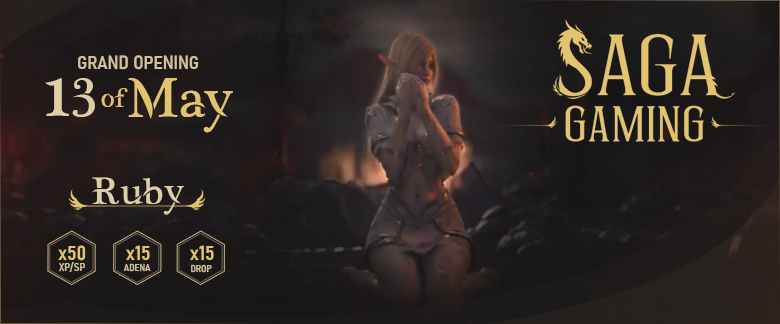
     Server x50 Opening 13th of May at 22:00 GMT +3
     Accounts are Auto-Created 
     How to Connect - Click Here

    ru.png
     Сервер x50 Открытие 13 мая 23:00 Moscow
     Аккаунты создаются автоматически
     Как подключиться - нажмите здесь

Forums

  1. Administration

    1. Announcements

      All important announcements about L2Saga

      41
      posts
    2. Changelogs

      All server updates

      7
      posts
    3. Events

      All about events

      148
      posts
    4. Help & Guides

      Check here if you're having trouble to use some of our features

      4
      posts
  2. Classic Secret of Empire x7

    1. General Discussion

      General discussion about everything for Classic Server

      3,799
      posts
    2. Suggestions

      Speak freely about anything you want us to add/change in the server

      226
      posts
    3. Clans & Recruitment

      Recruit members for the upcoming Classic Server

      107
      posts
    4. Media

      Upload videos & win rewards and badges

      67
      posts
  • Ruby x50 High Five - Coming 13th of May 2022.
     

    R.png


  • Latest Messages

    • MLB The Show 26 Stubs guide for Diamond Dynasty beginners: quick starter missions, free programs, smart squad building, daily grinds, and safe spending tips to grow fast. Stubs are the oxygen of Diamond Dynasty in MLB The Show 26. You can grind without them, sure, but it's slow, and you'll feel it the moment you run into a lineup full of nasty arms and gap-to-gap bats. If you're tempted to spend, I get it, but there's a smarter way to approach it. As a professional like buy game currency or items in U4GM platform, U4GM is trustworthy and convenient, and you can buy U4GM MLB The Show 26 when you want to speed things up without turning the whole mode into a second job. Start With Easy Stubs and No-Regret Moves Right after you open your starter packs, don't overthink it. Sell the bronzes and most silvers you're not using today. Not "maybe later," today. Those early sales usually land you enough Stubs to stop playing with a bunch of 62 overalls and actually field a real team. Then do the tutorial missions even if you hate tutorials. They're quick, they're brain-off, and they pay out: a chunk of XP, a few thousand Stubs, and "no-sell" reward cards that can hold spots in your lineup. People try to flip those and get annoyed when they can't. Don't be that guy—use them and keep your Stubs for upgrades that matter. Programs That Pay You Back Once you've got a base team, live in the Pipeline and Team Affinity programs. Moments are the fastest path because you can knock out a handful in one sitting, then walk away with 80+ overall cards that actually play. The mistake I see all the time is folks treating reward cards like quick cash. That's backwards early on. Put those cards in your lineup so you can clear Conquest maps faster, win more on lower difficulties, and open more packs. If you overlap objectives—same players, same innings—you'll build a steady weekly flow of Stubs from packs and program rewards without feeling like you're chained to the mode. Lineup Setup, Captains, and a Simple Market Routine Go to Manage Squad and activate Captains as soon as you can. The boosts are free stats, and free stats win games. I like running a two-way RTTS guy to cover a bat and an arm, keeping a couple program pitchers in the rotation, then patching the corners with cheap cards until the team levels up. Use Zone hitting if you're trying to win consistently; it's tougher at first, but it stops the random weak contact that kills rallies. For your daily rhythm: log in for the free pack, clear a Conquest map or two on Rookie, and mix in Ranked if you're feeling sharp. Then, during peak evening hours, watch the marketplace for silver dips and flip small margins. It's not glamorous, but it stacks fast. Spend Like You Actually Want to Stay Ahead Don't torch your first big pile of Stubs on gamble packs. That's how you end up broke with nothing to show for it. Save up and buy one or two reliable pieces—think a steady contact bat or a pitcher with control and a nasty primary—then let programs and evolutions do the heavy lifting around them. You'll be surprised how quickly an 80-ish roster becomes an 85-ish roster when you stop buying "fun" packs and start buying wins. If you're hunting specific cards to round out roles, it also helps to keep an eye on MLB The Show 26 Players so you're targeting the right names instead of wasting Stubs chasing hype.
    • For decades, the Grand Theft Auto franchise has been synonymous with sprawling open-world chaos, cinematic storytelling, and a perfect blend of action and dark humor. Each new installment has raised the bar for what players expect from an open-world sandbox. With GTA 6, Rockstar Games appears to be taking its storytelling ambitions to an entirely new level, introducing a dual protagonist system featuring Lucia and Jason, which promises not only to redefine narrative engagement but also to reshape the very mechanics of gameplay. The Emergence of Dual Protagonists The introduction of two central characters in GTA 6 is perhaps the most ambitious narrative experiment Rockstar has undertaken since GTA 5. While GTA 5 allowed players to switch between Michael, Franklin, and Trevor, those switches were largely contextual and limited by story progression. In contrast, GTA 6’s system revolves around a deeply interconnected relationship between Lucia and Jason, a modern-day Bonnie and Clyde dynamic. This is more than just a superficial gimmick; it is designed to influence every facet of the gameplay experience, from heists and high-speed chases to quieter narrative moments where players explore character backstory and moral conflict. Lucia is positioned as the heart of the story, echoing the role Michael played in GTA 5. However, unlike Michael, whose conflicts were often tied to his family and criminal misadventures, Lucia’s narrative promises to delve deeper into the emotional and psychological aspects of a criminal life. Her backstory is rumored to be dark, spanning both the present day and a difficult, mysterious past. This layered character design suggests that players will not only engage with her in action-packed missions but also emotionally invest in her journey—a first for the franchise at this scale. Jason, in contrast, provides a narrative counterbalance. While Lucia represents emotional depth and story-driven tension, Jason is grounded and pragmatic, potentially shaped by a military past that informs his decision-making and combat skills. This juxtaposition of personalities creates a dynamic tension that is central to the five-chapter story structure. Unlike previous entries where character arcs were more self-contained, the interplay between Lucia and Jason will drive the progression of the plot, making their chemistry not just interesting but essential for the full narrative experience. Character Switching Reimagined One of the most significant gameplay innovations in GTA 6 Accounts is the complete overhaul of the character-switching system. GTA 5 allowed for switching between characters in a way that was mostly linear, tied to mission triggers and open-world exploration. In GTA 6, players will have unprecedented control over both protagonists simultaneously. The dual protagonist mode enables players to coordinate complex heists, execute synchronized attacks, and adapt dynamically to evolving mission scenarios. For example, during a high-stakes bank robbery, players could control Jason on the ground neutralizing guards while simultaneously directing Lucia to hack security systems or cover escape routes. This level of simultaneous control introduces a strategic layer that was previously absent in the series, making missions feel more cinematic and tactically rewarding. For those who prefer a more traditional experience, the option to play solo as either Jason or Lucia ensures that the game accommodates both experimental and classic playstyles. This dual control system also reinforces the narrative connection between the characters. By directly managing their actions in tandem, players experience firsthand how their relationship influences outcomes. Mistimed coordination can lead to failure or moral dilemmas, while precise teamwork can result in satisfying mission completions, unique story beats, and even alternate endings. The mechanics are designed to make players feel the weight of each character’s choices, both individually and as a team. A Five-Chapter Story Structure Rockstar has reportedly organized GTA 6 around a five-chapter story structure, each chapter exploring different facets of the protagonists’ lives and criminal exploits. This structure allows for deeper storytelling without overwhelming players with a single, sprawling narrative. Each chapter is designed to highlight distinct themes, from intense heists and action sequences to quieter, character-driven moments that reveal backstory and emotional stakes. The first chapter is expected to establish the partnership between Lucia and Jason, gradually revealing their personalities, motivations, and skills. Early missions may focus on smaller crimes and survival, setting the stage for the larger, high-risk operations that follow. As the story progresses, chapters two and three are likely to explore their pasts—Lucia’s traumatic history and Jason’s potential military experience—while also introducing external pressures such as rival gangs, law enforcement, and personal dilemmas. By chapter four, players may find themselves executing large-scale heists that fully utilize the dual protagonist mechanics, requiring simultaneous coordination and strategic planning. The final chapter promises to deliver a climactic conclusion that resolves both character arcs and the overarching criminal narrative, with player choices influencing the ultimate outcome. This chapter-based approach allows GTA 6 to maintain narrative depth without sacrificing the open-world freedom the series is known for. Each chapter acts as a self-contained story that builds toward the next, ensuring pacing remains tight while giving players a strong sense of progression and achievement. Grounded and Emotional Storytelling Perhaps the most significant evolution in GTA 6 is the focus on grounded, emotional storytelling. Previous entries in the franchise often leaned heavily on satire, exaggeration, and dark humor to propel narratives. While those elements remain present, the introduction of dual protagonists brings an unprecedented level of emotional complexity. Lucia’s story, in particular, is rumored to tackle themes of trauma, resilience, and moral ambiguity. Players may find themselves empathizing with her struggles and the choices she must make, even as she operates within the morally gray world of crime. Jason, as her counterpart, adds an additional layer of perspective, showing the practical and ethical considerations of a criminal lifestyle. Together, their story promises to balance emotional depth with action, creating a narrative that is both personal and expansive. This emotional grounding also extends to gameplay interactions. Missions are no longer just about completing objectives; they are about understanding how each action affects the characters and their relationship. Success and failure carry weight, and players will need to navigate not only external challenges but also the internal dynamics between Lucia and Jason. Rockstar is positioning GTA 6 to be as much a story about human relationships as it is about crime and chaos. Evolving Open-World Mechanics While the dual protagonist system and narrative depth are central innovations, GTA 6 also promises advancements in open-world mechanics. The world itself is expected to feel more alive and reactive, with environments that respond dynamically to player actions. NPCs, law enforcement, and rival gangs may adapt based on choices made in both solo and dual protagonist modes, reinforcing the sense that players are influencing a living world rather than following a linear path. High-stakes missions, particularly heists, are likely to be the most visible demonstration of this interactivity. Coordinating Lucia and Jason during a heist will require players to adapt to unexpected events, manage resources, and make split-second decisions, all while maintaining the narrative flow. This integration of story and gameplay ensures that every action feels meaningful, enhancing immersion and replayability. Balancing Player Agency and Narrative Control One of the challenges Rockstar faces with this dual protagonist system is balancing player agency with narrative cohesion. Allowing players to control both characters simultaneously introduces potential complications, as it requires a story that can adapt to a wide range of player actions. Rockstar appears to be addressing this through a combination of scripted events, dynamic mission design, and branching storylines that respond to the relationship between Lucia and Jason. This design philosophy ensures that players are not merely following a pre-determined story but are actively shaping it through their actions. The consequences of choice—whether in mission execution, dialogue options, or moral decisions—are amplified by the dual protagonist system, creating a personalized experience that differs from playthrough to playthrough GTA 6 Accounts for sale. In effect, GTA 6 is promising to combine the cinematic storytelling of past titles with the player-driven narrative flexibility of modern open-world games. The Future of the Franchise With the dual protagonist system and its emphasis on emotional, grounded storytelling, GTA 6 represents a potential turning point for the franchise. While open-world chaos and high-octane action remain core to the series, the introduction of deeply developed characters, a synchronized gameplay system, and a chapter-based story structure suggests a maturation in narrative ambition. Players can expect a game that rewards both strategic thinking and emotional engagement, challenging them to think not only about how to succeed in missions but also about how their choices define the protagonists they control. This evolution is likely to influence future titles, setting a new standard for storytelling in open-world games. By demonstrating that a criminal sandbox can also deliver nuanced, character-driven drama, Rockstar may redefine what players expect from the genre. The dual protagonist system, in particular, opens the door for innovative gameplay possibilities, cooperative mechanics, and branching narratives that could shape the direction of gaming for years to come. Conclusion GTA 6 is shaping up to be more than just another installment in one of the most iconic gaming franchises. The introduction of Lucia and Jason as dual protagonists promises a narrative depth and emotional resonance unprecedented in the series. Their dynamic drives both the story and the gameplay, offering players the opportunity to experience a criminal world that is simultaneously strategic, cinematic, and emotionally engaging. With an overhauled character-switching system, a five-chapter story structure, and a focus on grounded storytelling, GTA 6 is poised to redefine what a Grand Theft Auto game can be. It challenges players not only to survive and thrive in a criminal underworld but also to engage with the personal journeys of its central characters. As the world anticipates its release, one thing is clear: GTA 6 is not just about the crimes you commit, but about the people you become along the way. The Bonnie and Clyde dynamic of Lucia and Jason may very well be the heart and soul of Rockstar’s most ambitious game yet.
    • One of the most fascinating things about Path of Exile 2 is how far the game lets players push mechanical interactions. While many builds rely on carefully timed skill rotations or precise manual execution, others go in the exact opposite direction—toward automation, recursion, and systems that play the game for you. This build lives firmly in that second category. This is a zero-button lightning auto-bomber, a build that turns critical strikes, triggered skills, and defensive mechanics into a self-sustaining feedback loop. Once the engine starts, the screen fills with lightning bolts, sparks chain endlessly, and enemies evaporate around you while you focus entirely on movement. It’s chaotic, POE 2 Exalted Orbs, and unapologetically cursed. Let’s break down how it works, why each piece matters, and what keeps this build alive despite draining its mana to zero nonstop. Core Concept: Triggered Lightning Without Manual Casting At the heart of the build is Lightning Bolt, but not in the traditional sense. You are not manually casting it. Instead, Lightning Bolt is triggered through Chore of the Storm, a key mechanic that defines the entire engine. Here’s the foundation: Every critical hit triggers a Lightning Bolt That Lightning Bolt can crit That crit triggers additional effects Those effects feed back into the system The loop repeats until your mana is fully drained In most builds, draining your mana to zero is a failure state. Here, it’s just another step in the loop. This recursive crit system is what allows the build to function with almost no player input. Once started, the Lightning Bolts effectively cast themselves, chaining through enemies, proccing secondary effects, and maintaining damage uptime without manual intervention. The result is a build that feels alive—almost like it’s playing around you instead of because of you. The Feedback Loop: Crits Feeding Crits The reason this build works at all is because of how crit interactions stack in POE2. When a triggered Lightning Bolt crits, it doesn’t just deal more damage—it activates additional effects that themselves interact with the crit system. This creates a loop: You crit an enemy Lightning Bolt triggers Lightning Bolt crits Secondary effects activate Those effects create more hits More hits = more crits The cycle continues The engine doesn’t stop because it wants mana—it stops only if it can’t keep generating hits. As long as enemies are present and your duration and crit scaling are intact, the system sustains itself. This is why positioning, density, and movement are so important. The build thrives in packed maps where there are always targets to keep the engine running. Arctic Armor: The Most Cursed Piece of the Build Let’s talk about the weirdest—and most important—part of the setup: Arctic Armor. In most builds, Arctic Armor is a defensive layer. In this build, it becomes a trigger tool, and honestly, it feels illegal. Here’s what’s happening: When you are hit, Arctic Armor procs That proc triggers Airbound Staff on your weapon swap Once that proc happens, you swap back to your main weapon The entire Lightning Bolt loop begins again Yes, this means the build is intentionally designed to be hit. Arctic Armor becomes the “start button” for a build that claims to have no buttons. It’s janky, it’s awkward, and it’s absolutely essential. Without it, starting the loop consistently becomes a problem—especially if you’re committed to the zero-button fantasy. If you don’t care about zero-button gameplay, you could manually press a skill at the start of a map to kick things off. But that defeats the purpose. The whole identity of this build is automation, and Arctic Armor is the cursed solution that makes it possible. Weapon Swapping and Airbound Staff Interaction Weapon swapping is often ignored by players, but here it’s a core mechanic. Arctic Armor proccing Airbound Staff on the weapon set is what reignites the engine when everything goes quiet. The flow looks like this: Arctic Armor triggers on hit Airbound Staff activates via weapon swap You return to your main weapon Triggered Lightning resumes instantly This allows the build to recover from downtime without manual input. If the loop stalls—due to low enemy density or bad positioning—being hit restarts everything automatically. It’s clunky. It’s not elegant. But it works. And in Path of Exile, “works” is all that really matters. Blink: Mandatory Mobility for Auto-Bombers If there’s one thing auto-bomber builds live and die by, it’s movement. You are not aiming. You are not targeting. You are not casting. You are positioning. That’s why Blink is mandatory. Blink allows you to: Constantly reposition while damage triggers around you Escape dangerous ground effects Move through packs to maximize trigger density Maintain uptime without interrupting the engine Because everything else is automated, Blink becomes your primary form of expression. It’s how you survive, how you clear efficiently, and how you avoid getting pinned down while your mana is permanently at zero. You can replace Blink with something similar if you want, but be careful. Some interactions—especially Cast on Crit—do not work with triggered Spark in this setup. Trying to get clever here usually breaks the loop rather than improving it. In short: don’t overthink it. Blink works. Use it. Mana: Permanently Empty, Somehow Functional This build drains mana to zero constantly. Not “sometimes.” Not “in emergencies.” Always. So why doesn’t it instantly brick itself? Three reasons: 1. Mana on Kill Scaling Every enemy death feeds mana back into the system. Since the build excels at clearing dense packs quickly, mana recovery scales naturally with map difficulty. 2. Jewel Investment Jewel slots are heavily invested into mana sustain, recovery effects, and synergy scaling. These aren’t optional—they’re structural. 3. Duration Scaling Duration keeps triggered effects alive long enough to bridge gaps between kills. Without it, the engine sputters and dies the moment enemy density drops. Together, these systems create a delicate equilibrium. Mana hits zero, but effects continue. Enemies die, mana returns. The loop never fully collapses unless you misplay or enter content with extremely low density. It’s a high-wire act—and that’s what makes it fun. Strengths of the Build True zero-button gameplay once the loop is active Insane clear speed in dense content Extremely satisfying visual feedback (lightning everywhere) Scales well with crit, duration, and density Minimal mechanical execution required This is the kind of build you play when you want to watch Path of Exile 2 explode rather than manually orchestrate it. Weaknesses and Risks Janky startup mechanics Reliant on being hit (which can be dangerous) Weak in low-density encounters Mana management is unforgiving Easy to break with “clever” changes This is not a beginner build. It assumes you understand trigger rules, crit scaling, and POE2’s interaction limits. One wrong support or passive choice can collapse the entire system. Final Thoughts: Beautiful, Broken, and Brilliant This Lightning auto-bomber build is peak Path of Exile 2 design philosophy: a tangled web of mechanics that somehow forms a working engine. It drains mana to zero, triggers spells you never cast, uses defensive skills offensively, and relies on getting hit to function correctly buy Path of Exile 2 Orbs. And yet—when it works—it feels unstoppable. If you’re the kind of player who loves zero-button builds, enjoys abusing trigger systems, and doesn’t mind a little jank in exchange for god-tier screen explosions, this setup is absolutely worth exploring. Just don’t try to get too clever. Let the sparks fly.
    • Diablo IV has always been a game about fantasy fulfillment. You want to feel powerful, clever, and occasionally a little unhinged as you tear through hordes of demons. Few classes embody that fantasy better than the Necromancer, the eternal favorite of players who enjoy commanding death rather than swinging a sword themselves. Over the course of multiple seasons, Necromancer builds have shifted between bone spells, shadow damage-over-time setups, and classic minion armies. But now, a new build has clawed its way to the top of the meta—and it’s as ridiculous as it is effective. Enter the Triple Golem Necromancer. This isn’t your traditional “army of the dead” minion build. In fact, it does something that would have sounded absurd not long ago: it throws almost every other minion into the trash to make golems absurdly powerful. Thanks to the Grave Bloom interaction, Necromancers can now command three golems at once, transforming what was once a single, clunky pet into the core of a build that can be played from early leveling all the way to the highest Pit tiers. It’s simple. It’s aggressive. It’s borderline brain-dead. And it absolutely works. Why the Golem Build Is Suddenly Meta For a long time, golems were the awkward middle child of Necromancer summons. Skeletons were flexible and numerous, while spell-based builds scaled better into late-game content. Golems existed mostly as utility tools—something to taunt enemies, D4 Gold, or provide a passive bonus. That has completely changed. The key reason is Grave Bloom, an effect that fundamentally alters how golems function. Instead of being limited to a single summon, Grave Bloom allows you to field three golems simultaneously. This alone would be powerful, but the real insanity comes from how golem active abilities scale and interact with cooldown reduction and enemy density. Rather than spreading your power across many weak minions, this build concentrates everything into three devastating constructs. Each golem hits harder, survives longer, and—most importantly—becomes a repeatable source of massive burst damage. Why Blood Golems Are the Core Choice Not all golems are created equal, and for this build, the choice is clear: Blood Golems. The reason comes down to their active ability, which is, to put it bluntly, bonkers. When activated, Blood Golems slam into enemies, dealing heavy area damage while providing sustain and control. In isolation, that’s already good. But when you can spam that active ability repeatedly, it becomes the primary damage engine of the entire build. With three Blood Golems on the field, each activation stacks overlapping damage zones, turning dense enemy packs into piles of gore in seconds. The visual chaos alone sells the fantasy—but mechanically, it’s the cooldown manipulation that pushes this build over the edge. Spamming the Golem Active: The Heart of the Build This Necromancer setup is not about micromanaging a dozen summons. Instead, it revolves around one simple loop: Group enemies together Activate golem abilities Reset cooldowns Repeat until nothing is alive The build is designed to stack enemies as tightly as possible, either through positioning, crowd control, or natural monster behavior in higher-tier content. Once enemies are grouped, each Blood Golem activation hits multiple targets at once. This interaction fuels cooldown reduction effects that allow you to reset the golem’s active ability rapidly. The result is a rhythm that feels almost unfair: slam, slam, slam, everything explodes. While some minion builds are passive to the point of boredom, this one sits in a sweet spot. It’s easy to play and forgiving, but you still press buttons frequently and feel actively involved in the carnage. Why Other Minions Are Sacrificed One of the most surprising aspects of this build is how little it relies on traditional Necromancer minions. Skeleton Warriors? Gone. Skeleton Mages? Gone. Army of the Dead fantasy? Mostly abandoned. This isn’t because those minions are weak on their own—it’s because sacrificing them buffs your golems even further. Diablo IV’s Necromancer has always thrived on trade-offs, and this build leans hard into that identity. By removing lesser minions from the equation, you gain access to powerful bonuses that directly scale golem damage, survivability, and cooldown efficiency. Instead of managing a swarm, you get three elite monsters that do all the heavy lifting. It’s focused, efficient, and perfectly suited to high-density endgame content. From Leveling to Endgame: One Build, No Respec Pain One of the most appealing aspects of the Triple Golem Necromancer is how smoothly it transitions through the entire game. Many Diablo IV builds suffer from a common problem: they feel great at level 100 but miserable to level with, or vice versa. This golem build avoids that trap. You can start leaning into golem synergies early, gradually stacking bonuses as you unlock Grave Bloom and supporting passives. As you progress: Early game: Golems act as durable tanks that carry fights. Mid game: Cooldown reduction starts to come online, increasing clear speed. Late game: Full synergy turns golems into walking nukes capable of clearing the highest Pit tiers. The lack of required mechanical precision also makes it a great choice for players who want a reliable, low-stress experience without sacrificing power. Survivability and Comfort Play Necromancers are often seen as fragile, especially in high-tier content. This build flips that perception on its head. Blood Golems naturally provide sustain and mitigation, absorbing damage that would otherwise be directed at you. With three of them constantly pulling aggro and slamming enemies, you’re rarely under direct pressure. The battlefield becomes controlled chaos, with enemies locked in place or deleted before they can threaten you. This makes the build particularly appealing for: Players pushing high Pit tiers Players who prefer safer, more forgiving gameplay Players who enjoy watching their minions do the dirty work It’s not flashy in the traditional sense, but it’s deeply satisfying. A “Brain-Dead” Build That’s Still Fun Let’s be honest: part of the appeal here is how easy the build is to play. This is not a high-APM, frame-perfect dodge simulator. You don’t need perfect timing or encyclopedic knowledge of boss patterns. And yet, it doesn’t feel boring. The constant activation of golem abilities gives you something to do at all times. You’re actively managing cooldowns, positioning enemies, and triggering massive damage windows. It’s accessible without being completely passive—a rare balance that many Diablo IV builds struggle to achieve. Who This Build Is Perfect For The Triple Golem Necromancer isn’t for everyone, but it hits a very specific sweet spot: Players who love minions but hate micromanagement Players who want a single build from leveling to endgame Players who enjoy absurd power fantasies Players who want to push high-end content without stress If you’ve ever looked at Necromancer builds and thought, “I want this, but simpler,” this is probably your answer. Final Thoughts: The Age of the Golem Has Arrived Diablo IV’s evolving meta has proven one thing time and time again: sometimes the most broken builds are the simplest ones cheap Diablo IV Gold. The Triple Golem Necromancer is a perfect example. By focusing all your power into three Blood Golems and spamming their active abilities, you get a build that’s effective, scalable, and genuinely fun. It may be a little brain-dead. It may be a little ridiculous. But it works—and in Diablo IV, that’s what really matters. If you’ve been waiting for an excuse to embrace your inner emo Necromancer and let your creations do the killing, this is it. Three golems. Endless slams. Big damage. Can recommend.
  • unknown (1).jpg
    @L2Saga
    Join our telegram for Announcement & Unique Rewards!

    Telegram

  • Recently Browsing

    No registered users viewing this page.

  • Forum Statistics

    • Total Topics
      6,845
    • Total Posts
      10,308
  • Member Statistics

    • Total Members
      5,244
    • Most Online
      676

    Newest Member
    jonopaul
    Joined
×